
Vibe Coding
With the Outskill Generative AI Bootcamp kicking off on October 9th, I’ve been getting hands-on with "vibe coding"—steering AI agents to build software rather than manually typing every line of syntax. To pressure-test this workflow, I am building a custom Spanish language tutor application.
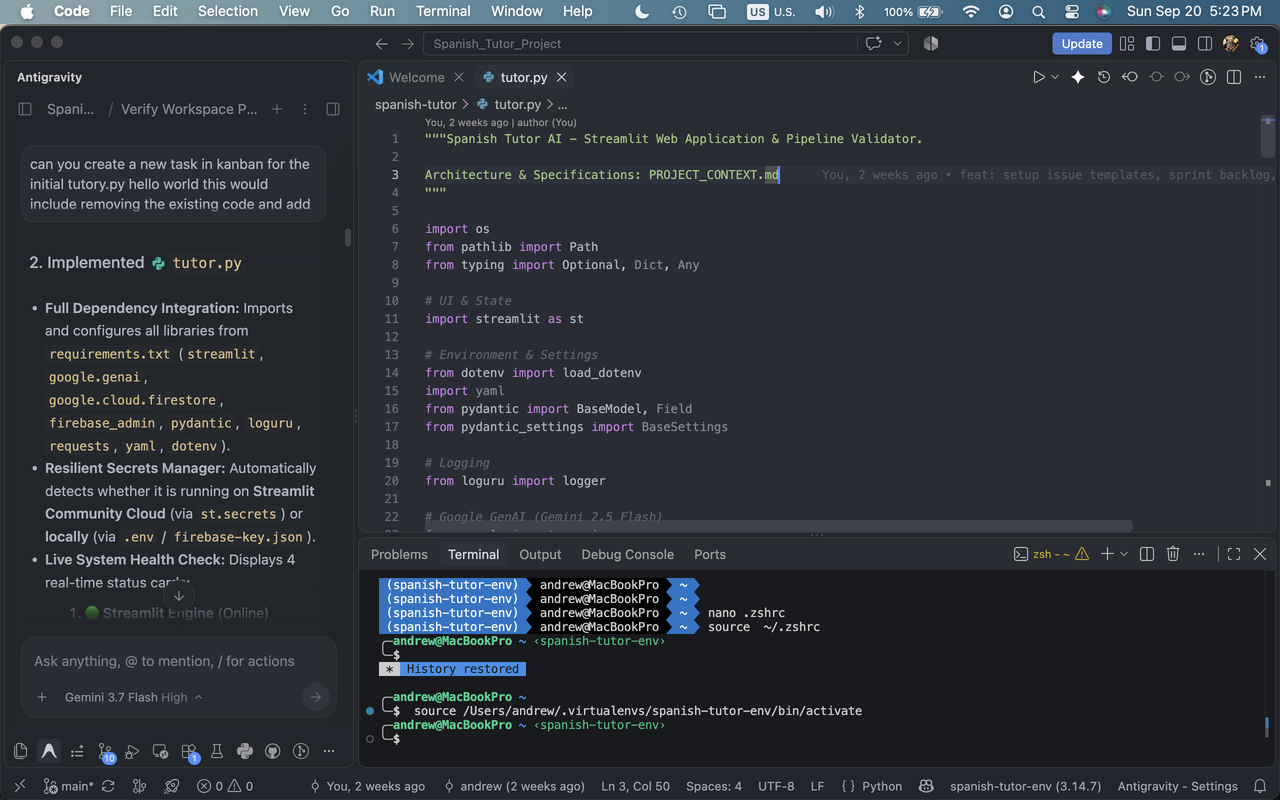
Here is a breakdown of the development stack, the architecture, and the learning curve of building software by talking to it.
The Vibe Coding Workbench
My current local environment is built entirely around AI-assisted development:
- IDE & Orchestration: VS Code equipped with Google Antigravity and Cline.
- Framework: Streamlit for rapid Python web UI development (
tutor.py). - Database: Firebase/Firestore (handling data persistence for v1, a necessary step up from local JSON storage).
- The Brain: Gemini API (leveraging the Google AI Plus tier) to power the core language processing and conversational personas (Mateo and Gabriella).
- Deployment & Versioning: Git, GitHub, and Streamlit Community Cloud.
The Build Process: Agents vs. Prompts
Building the app has been a massive exercise in understanding how to actually manage AI tools. One of the biggest early takeaways has been navigating the balance between prompt complexity and agent execution.
When you start adding audio input widgets and conversational role-play into a Streamlit app, you quickly realize you cannot just rely on one massive prompt. I am learning to balance fast, front-end role-play responses with slower, background agent tasks. Watching an AI agent automatically build, test, and deploy code is incredible, but it also highlighted the need to sometimes force a slower-paced execution. You have to maintain control over message queue limits, failure handling, and post-chat triggers so the system doesn't run away from you.
Connecting the Dots
Right now, the focus is on bridging my Gemini notebook environments directly with Antigravity in VS Code. It is a fundamental shift from traditional coding to systems architecture—defining the rules, setting up the Firebase pipeline, and letting the AI generate the boilerplate.
This is still raw R&D, but it proves the core thesis of this blog: you don't need to be a traditional full-stack engineer to build functional, scalable digital products if you know how to manage the systems doing the heavy lifting.